
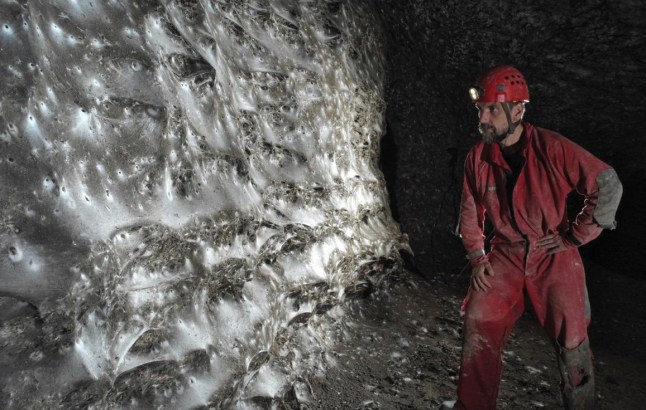
It’s not one giant web,but countless small ones meshed together (Picture: Subterranean Biology)
Right now,as you read this,more than 110,000 arachnids are crawling around the world’s largest spiderweb.
The ‘extraordinary’ but skin-crawling discovery was made inside a pitch-black cave on the Albanian–Greek border.
The web stretches 1,140 square feet – about the size of a semi-detached house in the UK – and is home to two species of spider.
One is the Tegenaria domestica, otherwise called domestic house spiders,while the other is the far smaller sheet weaver,Prinerigone vagans.
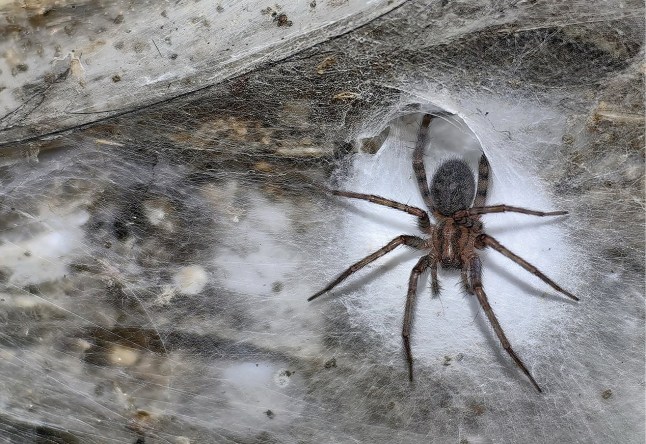
Domestic house spider,also called a barn funnel weaver in the US (Picture: Subterranean Biology)
Both live together within a patchwork of webs spread along the wall of a low-ceilinged passage,according to a study published in the journal Subterranean Biology.
The spider lair was discovered in the Sulfur Cave,a chamber hollowed out by sulphuric acid formed when hydrogen sulphide – an egg-smelling gas – from groundwater reacted with oxygen.
Spiders aren’t exactly known to be social creatures,so this might be the first example of two arachnids creating a colony,Jason Dunlop,a curator of arachnids and myriapods at the Berlin Natural History Museum,toldMetro.
‘What’s fascinating here is,firstly,that there is a group of communally living spiders in a cave,’ said Dunlop.
‘Most spiders are solitary,but a few species are known to live in groups,although these usually build large communal webs outdoors covering a whole tree or bush.’
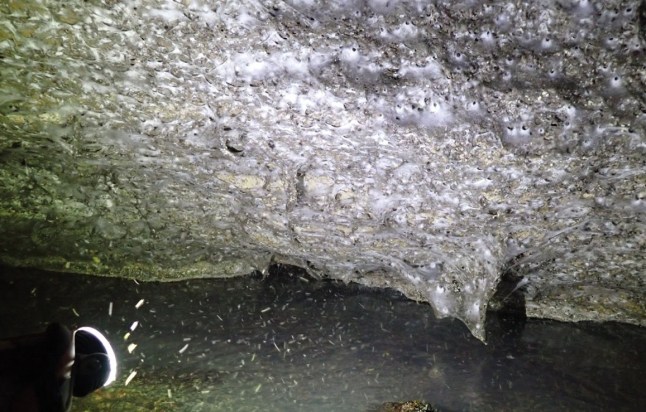
This is one of the first times two species of spiders have formed a ‘colony’,the study said (Picture: Subterranean Biology)
‘What’s really unexpected is that two rather different species of spider from two different families are involved: a kind of house spider like the one that sometimes appears in the bath and a smaller money spider.
‘That’s unique as far as I’m aware.’
The sprawling web was first spotted by cavers from the Czech Speleological Society in 2022.
Researchers from the Sapientia Hungarian University of Transylvania in Romania visited the cave two years later to analyse the some 69,000 T. domestica and 42,000 P. vagans lurking inside.
What took scientists off guard was that P. vagans are usually on the menu for the larger domestic house spiders.
They instead found the T. domestica nibbled on tiny,non-biting midges – though,they suggested this is because the lack of sunlight means the larger spiders simply can’t see their smaller housemates.
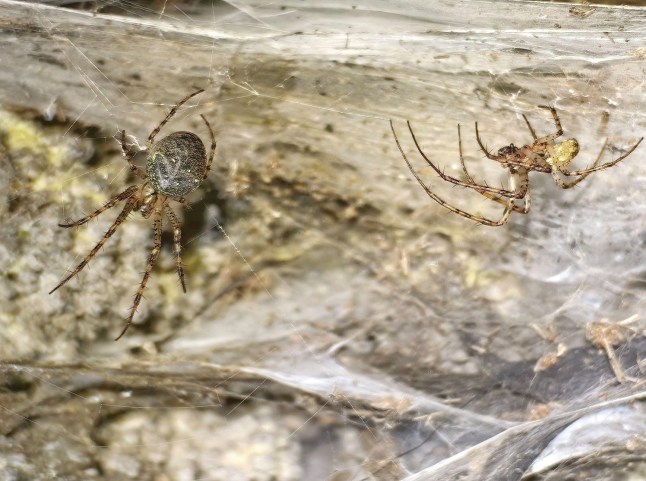
A third species of spider,the Metellina merianae,lived close but not within the massive web (Picture: Subterranean Biology)
‘Spiders are usually pretty cannibalistic and bigger ones would usually cheerfully eat little ones,’ added Dunlop.
‘What the authors of the study are suggesting here is that this very unusual arrangement is only possible because there is an abundance of small flies in the cave,which means there is food enough for everyone,even when living at impressive densities of tens of thousands of individuals.’
By peaking inside the stomachs of both spiders,the researchers found that they are one part of a complex ecosystem.
The midges feasted on by domestic house spiders eat white microbial biofilms,the slimy cling film that sulphur-oxidising bacteria exert.
By indirectly eating these bacteria,the spiders were enjoying a sulphur-rich diet that made them less diverse over time.
Rather,these creepy-crawlies had adapted to life in darkness and rarely,if ever,venture outside.
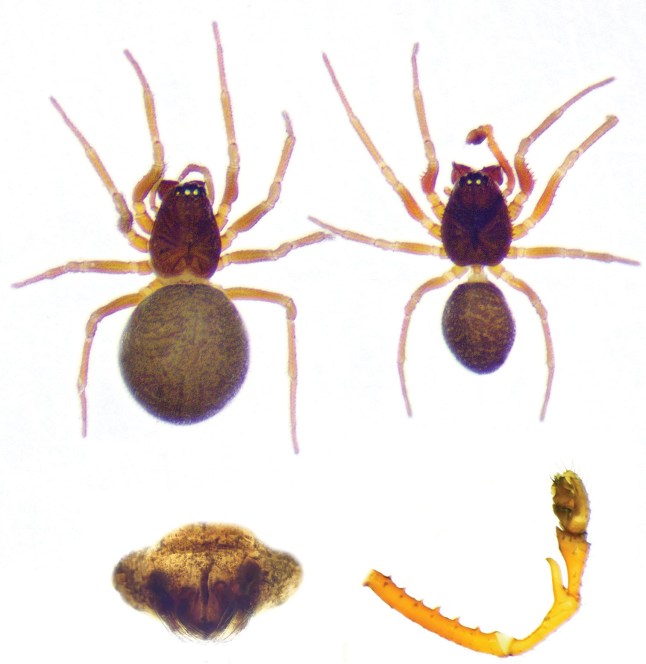
One arachnologist told Metro that how the larger spiders don’t gnaw on the smaller species is surprising (Picture: Subterranean Biology)
Even more species of spiders were found deeper in the cave,the researchers said: the spindly Kryptonesticus eremita and the tiny,blind Cataleptoneta.
‘Both K. eremita and Cataleptoneta sp. were present in large numbers but were spatially limited to areas where the cave walls were moist and free of gypsum crusts,’ the study said,referring to a calcium mineral.
Metellina merianae,a striped orb-web spider,was the spider megacity’s closest neighbour – researchers said they were larger than average,probably because of the abundant food around them.
‘It’s also worth stressing that this is not like a bee’s nest or an ant or wasp colony,’ added Dunlop.
‘There is no one “queen” spider coordinating all this,it’s more like a “flat share” where lots and lots of spiders have converged together and share a particular space close to a remarkably rich food source.
It comes after a species of spider long-feared extinct,the white-knuckled wolf spider,was recently found on the Isle of Wight.
© Bitcoin Telegraph